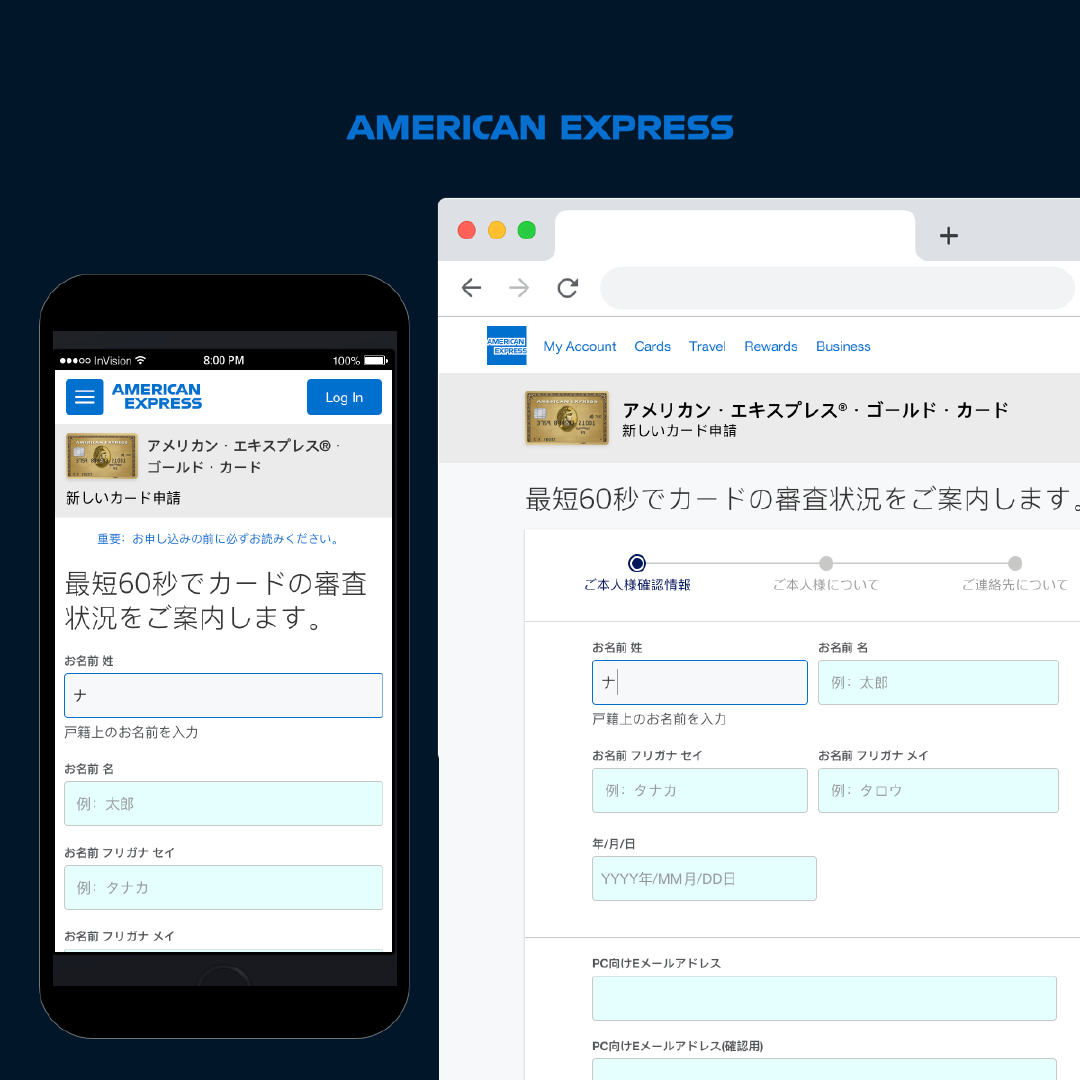


This work was not just about redesigning a form. It was about creating a reusable application system that could move faster across markets without breaking compliance or conversion.
Context
American Express needed to redesign international credit card application journeys across multiple markets while integrating a new risk engine and preserving local compliance requirements.
The work spanned more than twenty card products, multiple regions, and a dense stakeholder network across product, legal, risk, marketing, and engineering. The existing state was fragmented, hard to scale, and too expensive to adapt market by market.
The opportunity was to create a modular system that could preserve local relevance while making launches faster, clearer, and more repeatable.
Problem
- Application journeys varied significantly across markets and products.
- Regulatory and risk requirements created high complexity and frequent rework.
- Legacy flows made reuse difficult and slowed time-to-market.
- Stakeholders lacked a common structure for aligning requirements and design decisions.
- The system needed to support growth without disrupting acquisition goals.
Constraints
- Local compliance requirements varied by market.
- The new risk engine introduced technical and experience complexity.
- Reuse mattered, but local flexibility could not be lost.
- The work had to support phased launches across many products and regions.
Research Findings
The core issue was not just inconsistency in screen design. It was the absence of a shared system for handling variation.
Discovery work showed:
- Common journey patterns existed across markets, but they were buried under local exceptions
- Regulatory and risk logic needed to be visible earlier in the design process
- Teams were recreating similar solutions instead of working from a shared framework
- Faster launches would depend on modularity, not one-off redesigns
To make progress, I built a structured discovery approach that helped teams align on journey steps, risk triggers, and market-specific requirements.

Key Decisions
1. Design for modularity, not one-off optimization
The system needed reusable building blocks that could be configured by market and product instead of recreated from scratch.
2. Make regulatory and risk logic part of the experience architecture
Compliance and risk were not edge conditions. They shaped core flow behavior, sequencing, and content.
3. Use shared frameworks to align teams early
Journey maps, templates, and flow diagrams created a common language across stakeholders who usually entered the work from very different perspectives.
4. Sequence rollout in a way that compounds reuse
Later launches would only get faster if the system was designed and governed with repeatability in mind from the start.
System / Workflow / Experience Design
The design work focused on creating a structured application system that could support both reuse and controlled variation.
Core components included:
- conditional flows tied to risk and product logic
- reusable templates and layout patterns
- shared content and interaction models
- configurable integration points for market-specific requirements


Validation / Rollout
The rollout strategy was designed to strengthen the system with each launch rather than treat each market as a separate redesign effort.
Validation and launch support included:
- phased deployment by market complexity
- stakeholder reviews with product, legal, risk, and engineering
- rollout dashboards and readiness checks
- adjustments based on launch learnings from earlier markets

Outcomes
What I Learned
- Scalability is an architectural decision. It has to be designed into the system early.
- Discovery frameworks can speed delivery. Shared structure reduced ambiguity across a very large stakeholder network.
- Modularity works when variation is respected. Good systems allow local fit without becoming bespoke again.
- Complex journeys get easier when teams can see the logic. Flows, templates, and maps became alignment tools as much as design artifacts.


